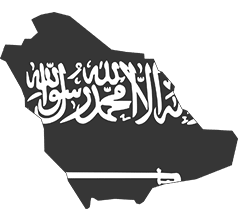
Saudi Arabia is the largest economic power in the Middle East and the richest Arab country. The government's policy of hard work and foreign direct investment, together with the soundness of the banking and financial system, have made the country the world's leading regional economy and one of the largest in the world. But the kingdom's economy is almost entirely based on oil and the fall in oil prices has led to a slowdown in growth. After reaching 3.5% of GDP in 2015, Saudi Arabia's economic growth fell sharply in 2016 to an estimated 1.2% of GDP. A gradual recovery is expected in 2017, supported by rising oil prices.
In 2016, Saudi Arabia's economic activity continued to slow as a result of low oil prices, reaching its lowest level since the 2009 recession. Government revenues continued to contract and non-oil revenues were constrained by the slowdown in non-oil activity. The government has pursued a strict policy of tightening budgets, freezing salaries and suspending investment projects, which has reduced spending. The general government deficit reached 14.1% of GDP, up sharply from 2015 but below expectations. Public debt (14% GDP) has risen sharply but remains sustainable due to Saudi Arabia's large reserves. Faced with the erosion of the latter, the authorities launched for the first time a USD 17 billion bond issue on the international financial markets. In April, the government presented its Saudi Vision 2030 development plan and announced the launch of a privatization program, including the Aramco oil monopoly. The National Transformation Programme 2020 was launched a month later, with the objectives of increasing non-oil revenues, creating jobs and increasing women's participation in the labour market. The 2017 budget puts an end to the policy of austerity and provides for measures to support growth. The Vienna agreement signed between the various OPEC members should lead to a slight increase in oil prices. The major challenge for the government is the security threat posed by conflicts in neighbouring countries. In 2016, tensions with Iran increased.
The standard of living is one of the highest in the region with a GDP per capita of more than 20,000 USD. Nevertheless, the country is still marked by an unemployment rate of around 12%, affecting mainly young people, and high levels of inequality. Agriculture accounts for about 2% of the country's GDP and employs about 5% of the active population. This sector is not very productive despite the massive investments of the state. Saudi Arabia, due to the geographical and climatic constraints weighing on its relief (drought) imports most of its needs in agricultural and agri-food products. Water scarcity is a serious regional problem that the country is expected to face in the coming years, as wheat cultivation is a serious threat to deplete water supplies.
The industrial sector accounts for more than 45% of GDP. It is dominated by non-manufacturing activities (oil extraction). The country has the largest oil reserves in the world and is also the world's largest oil producer and exporter. Oil accounts for more than 90% of the country's exports and nearly 80% of government revenues. The share of the non-oil industrial sector is growing as a result of Saudi investments in economic diversification. Finally, services account for more than 50% of GDP and employ a large majority of the population. This sector is dominated mainly by tourism, financial and banking services and insurance. Tourism generates very high revenues (nearly 4 million tourists per year), exclusively through pilgrimage to Mecca.
For lovers of old stones, you should also visit Domat al-Jandal, an important archaeological site. In the middle of the arid desert is the immense ancient Nabataean city of Madahine-Saleh, recognized as a UNESCO World Heritage Site and containing tombs dug in the sandstone rock that were built between the 1st century BC and the 1st century AD. Qasr Farid, is the most important and isolated burial ground. It is the "symbol" of the place just like the Diwan, the meeting room.
Saudi Arabia enjoys a mild but very warm and intense climate. Temperatures can reach fairly high temperature peaks of up to 45°-50° C. In the winter months such as December or January temperatures drop significantly (at around 15° C).
By stopping in Saudi Arabia you will be amazed by the beauty of the places of worship. Mosques are of great value to the Saudis, who are very believers. In the capital several buildings with Islamic architecture of great beauty are to be visited such as the mosque Main Jum' ah, that of Al Murabba and that of Al Johara.
Saudi Arabia is home to the first holy city of Islam, Makkah, which shelters the Kaaba in the heart of the Masjid Al-Haram Mosque. The pilgrimage to Mecca is the fifth pillar of Islam. The sacred city, the birthplace of the Prophet Muhammad, is a place of recollection for millions of Muslims. Nearby is the holy city of Medina, home to the prophet's tomb.
Saudi Arabia is a land of religion. The rules imposed by Islam are respected by all. Thus women wear an "abaya", a kind of long black dress that conceals their bodies. Men wear pants as a sign of respect. The Saudis show great wisdom but also great hospitality towards the visitor who respects these customs. Saudi Arabia offers you a beautiful immersion in a healthy place where culture and history take on their full dimension.
Art and culture in Saudi Arabia
Islam being the state religion in Saudi Arabia, two festivals are very important: Eid-al-Adha (commemoration of the Sacrifice or Sheep's Day) and Aid Al Fitr, which celebrates the end of Ramadan. The Saudis take advantage of these special moments to visit their families and loved ones. February 15 celebrates the birth of the prophet Mohammed, the El Mouloud. On this occasion, religious songs are chanted all over the country and candles are generally lit in the homes. Some men also gather to slaughter sheep and pay homage to the prophet.
What to visit in Saudi Arabia
Majestic capital, Riyadh is a must during your stay in Saudi Arabia. Witnessing a fascinating past, the city is full of historical buildings very well preserved in the image of its citadel and its majestic palaces. To understand the history of the country, several museums open their doors to you. Riyadh also shelters beautiful mosques that will plunge you into the heart of Islam. These monuments and the old town stand side by side with modern buildings and towers, most of which are located in the city centre. Before leaving the city do not forget to take a tour of the souk to bring back to your loved ones objects from the local crafts.
Gastronomic specialities in Saudi Arabia
The Saudi gastronomy gives a large part to the lunch where we find all the specialities of the country as the national dish par excellence: the "kabsah" or "kabsa", a preparation based on chicken and rice that can also be accommodated sheep, fish or shrimp. You can also order dishes such as grilled chicken, lamb skewers or refreshing soups and salads.
At breakfast the Saudi Arabs serve the traditional Khaliyat Anahl or beehive which is the national brioche made of small balls or filled with cheese, date paste, chocolate... The brioche is savoured with tea or coffee.