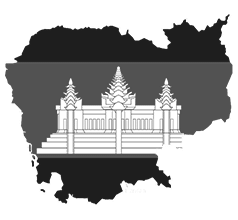





After 300 years of war and trauma, Cambodia is now peaceful and offers contrasting landscapes with countless treasures. The country is full of architectural masterpieces, including the fabulous Temple of Angkor. The diversity of its landscapes is breathtaking, from the forest to the high plains through the mountains or the sea, this country will never cease to amaze you. In the Land of Smiles, hospitality is legendary and Cambodians will welcome you with authentic kindness.
Southeast Asian countries located in the Indochinese peninsula, Cambodia borders Laos to the north, Thailand to the east, Vietnam to the east and the Gulf of Thailand to the southeast. It is a small country whose surface represents one third of that of France. The vegetation extends over the ¾ of the country with dense forests on the humid slopes and in the mountains along the coast and whose summit reaches 1 800 m of altitude. Savanna is present on the high plains and northern plateaus. The country is irrigated thanks to the Mekong, its feeding arm, and the Tonle Sap lake linking Phnom Penh to Angkor.
A flight to Cambodia
is first of all a dive into the history of the Khmer Empire through hundreds of temples dating from the 7th century. The country's architectural wealth also nests in cities and archaeological parks. But Cambodia also offers the possibility of an adventure trip: trekkers can observe elephants, tigers or leopards hiking in the many forests that adorn the country from southwest to northeast, or prefer the mountains. Water activities are numerous from the Mekong to the Gulf of Thailand. The amazing Tonle Sap Lake will be the fishermen's paradise, its floating villages with houses built on stilts and floats are amazing. Throughout your stay in Cambodia you will get to know a people who, despite their trials, remain smiling and offer tourists a warm and friendly welcome.
Cambodia has a tropical climate with a dry winter from November to March, an arid season in April and May and finally the summer monsoon from May to October during which humidity intensifies the sensation of heat. During the summer period, the daily life is punctuated by sometimes violent rainy moments. The best time to go to Cambodia is in winter, the climate is very pleasant with an average temperature of 25°C and sunny days.
Angkor intrigues and fascinates. This former capital of the Khmer Empire is one of the most prestigious archaeological sites in the world! Classified as World Heritage by UNESCO, the remains of Angkor are the heritage of the sovereigns of the Empire who built their temples from the 9th to the 14th century. Partly covered by forest vegetation and spread over 400km2, this archaeological park traces 600 years of history.
Angkor and its majestic ramparts were not only composed of stone or brick temples intended for the deities, but also of houses, palaces and public buildings built of wood and disappeared today. The whole formed a spectacular administrative and religious complex, witness of the power of this civilization which today makes the pride of Cambodia. To develop the infrastructures, an important irrigation system was developed thanks to the Mekong River which crosses the country on 500 km and the Tonle Sap Lake, classified Biosphere Reserve by UNESCO. The surface of Tonle Sap is multiplied by six during the rainy season to become the largest freshwater lake in Southeast Asia.
A haven of peace with contrasting landscapes, one goes there for culture, the richness of historical remains, to relax on the coast, to stroll in the forest or in the mountains.
Land of smiles, place of history with an astonishing cultural and architectural heritage, composed of breathtaking landscapes and inhabited by an endearing people.
To make the most of Cambodia, there are a few rules to follow. Avoid kissing in the streets and do not show signs of irritation in public. Choose proper clothing over short skirts and minishorts and if you enter a religious building, remember to take off your shoes.
Art and culture in Cambodia
Dance is considered a sacred artistic tradition. The Royal Ballet of Cambodia offers a singular show, the dancers' gestures are sensual and the physical performances impressive. If you booked a hotel in Cambodia in November, enjoy the many Buddhist festivals in the cities, villages and temples of the country. Also, don't miss the Bon Om Tuk festival. All over the country, Cambodians celebrate the reversal of the direction of the Tonie Sap River. In Phnom Penh and Siem Reap where the festivities are the most important, you can discover folklore, musical traditions and enjoy many fireworks.
What to visit in Cambodia
The Angkor region alone deserves a trip. Among its many temples, if you have to choose, Ankor Wat is the most majestic. Built in 35 years under King Suryavarman II, it is the largest religious building in the world with an outer perimeter of 5500 meters. Symbol of Cambodia, you will find it on bank notes but also on the flag of the nation.
Phnom Penh, the capital of the country, also deserves to be seen. Located in the Mekong basin, at the crossroads of the Mekong and Tonle Sap, it is very pleasant to take a river cruise or stroll along the lively quays.
Gastronomic specialities in Cambodia
The basis of Cambodian food is rice. It is often accompanied by a different soup or dish depending on the region. Grilled fish, rolled in a spinach leaf or in sauce are mainly eaten in the Tonle Sap region and on the coast. On the markets, do not hesitate to taste the toasted crickets or mygales, it is an astonishing culinary experience! You will find Loc-lac from everywhere, composed of succulent pieces of beef marinated in lemon and served with onions and fried eggs.