Ivory Coast seems to have it all. A multitude of landscapes, a cultural and ethnic diversity make it an ideal destination for a stay of discovery and relaxation where the change of scenery is total.
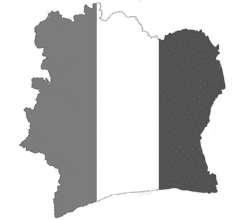
Independent since 1960, Ivory Coast is a West African State with an area of 322,463 km² surrounded by the Gulf of Guinea, Liberia, Guinea, Mali, Burkina and Ghana. Divided into nineteen regions (Lagoons, South-Comoé, Agnéby, Haut-Sassandra, Savanes, Bandama Valley, N'zi-Comoé, Moyen-Comoé, Montagnes, Lacs, Zanzan, Bas-Sassandra, Worodougou, Denguélé, Sud-Bandama, Marahoué, Fromager, Moyen-Cavally and Bafing), Côte d'Ivoire is rich of more than 8000 villages inhabited by different ethnic groups, about fifty, that are Senoufo, Malinké, Baoulé, Dan, Bété, Agni and many others. Côte d'Ivoire is therefore a country synonymous with diversity and wealth.
While travelling in Ivory Coast you will discover a breathtaking landscape. Essentially composed of savannas and equatorial forests, it also has magnificent lagoons, hills and plantations of palm trees, lemon trees, guava trees, banana trees, coffee trees... The sea is also an important element. On the coast you will find many fine sandy beaches suitable for idleness and water sports.
Water in all its forms is present in the country which counts four rivers (Comoé, Bandama, Sassandra, Cavally) and a multitude of rivers. Charming villages with brick houses dot these landscapes. All around are fields where fruit trees (papaya, mango and banana trees) flourish.
Côte d'Ivoire benefits from several types of climates because of its imposing surface. Thus the north enjoys a fairly tropical climate (with a rainy season extending from May to November) while the south is rather equatorial and therefore humid. For your stay, please allow your calendar according to the region you are visiting. If you are travelling to the coast, it is better to wait until the dry season from December to April to book a flight in Côte d'Ivoire. Inland, the most favourable period runs from October to February.
Côte d'Ivoire is a huge crossroads where about sixty ethnic groups live peacefully together, each with its own culture and rites, often accompanied by rhythmic dances to the sounds of the drum-toms. People enable the country to acquire a great cultural wealth.
They live in harmony by grouping themselves into four large entities: in the Centre are mainly the Akans; in the South-West is the Krou group made up of the Bété, Didas, Wês Yacoubas. In the West and North you will find the group Mandé with the Malinkés, Dioulas, Yacoubas, Gouros and the group Voltaïque with the Sénoufos, Koulangos, Lobis. All have their own artistic sense. For example, the Dan and Baoule peoples produce majestic masks and statues of rare beauty and great cultural value.
Côte d'Ivoire is rich in impressively diverse fauna and flora. To keep them intact the country has opened many national parks. The largest is the Comoé Park where many lions, elephants, monkeys, felines live... Other species such as buffaloes, buffalo cobs, rhinos or giraffes live in the heart of the Abokonamékro National Park.
The Asagny National Park will welcome you in a swampy savannah filled with palm trees where elephants, bushpigs, birds flourishing peacefully. You can discover them on board a boat which will go down the Canal d'Asagny. Many other parks, each with its own specificities, are also worth a visit, so don't hesitate to discover them.
Côte d'Ivoire is a country that delights all nature lovers in all its forms. Walking through the country you will meet fabulous landscapes and traditional villages where live ethnic groups with great generosity who will make you discover their traditions and ways of life. A journey under the sign of knowledge and sharing where we return transformed and grows.
Art and culture in Ivory Coast
Côte d'Ivoire gives great importance to traditions. Thus several celebrations are close to the hearts of Ivorians such as the Sheep Festival which takes place in January or the Independence Day in August. November celebrates Peace Day while December is also the occasion to pay tribute to the death of Félix Houphouët Boigny (first president of the country). These events often give rise to folk dances and songs. Africans then dance to the sound of the djembe and balafon, typical instruments, or gather around the griot (a kind of communicator) and its kora. What to visit in Ivory Coast
The economic capital of the country, Abidjan, seems the crossroads of all Ivorian cultures. Resolutely contemporary and dynamic, the "Manhattan of Africa" or "Manhattan of the tropics" is rich in modern architecture dotted with skyscrapers. Nestled between its buildings are magnificent trees under which the inhabitants like to distract themselves by playing checkers and awale (a kind of African "chess"). The residential district of Cocody will change your scenery with its flower market, pottery and craft sculptures. The city also marvels by its magnificent beaches lined with palm and coconut trees.
Gastronomic specialities in Ivory Coast
Ivorian gastronomy reflects its population: diversified and generous. Thus many influences from all over the world enrich his cuisine. You will be able to taste in the majority of the restaurants of the hotels of Ivory Coast several specialities such as the braised chicken and the guinea fowl soup decorated with rice or pasta.
As far as drinks are concerned, Côte d'Ivoire offers juicy fruit juices such as bissap (African infusion based on hibiscus flowers), Gnamakoudji (ginger juice) and other juices based on grapefruit, passion fruit, orange or pineapple. For alcoholic drinks, taste a Kotoukou, an artisanal eau-de-vie.