Known above all for its rally drivers, Finland is nevertheless a country at the forefront of ecology where nature, with its forests pierced by thousands of lakes, reigns supreme over a people with Germanic, Baltic and Sami influences, the indigenous Scandinavian people heir to a very ancient culture.
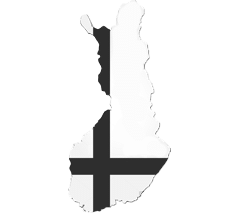
Finland is as large as two thirds of France, or 338,145 km2, and has a small population of 5.3 million. Between Sweden in the west, Norway in the north and Russia in the east, it is part of Eastern Europe. Its coastline is rugged: more than 4,600 km ! It is strewn with islands and islets, dotted with lakes, and often offers the appearance of a calm inland sea. However, isostasy, a geological phenomenon of equilibrium between the earth's crust, results in the rise of granitic rocks compacted by glaciers at a rate of almost one meter per century!
While the southwest and the Aland Islands are the warmest part of the country, the interior is the kingdom of lakes: more than 180,000 ! Sculpted by glaciers, long ridges, called eskers or ös by geologists, twist between water bodies. Further north, Lapland is the land of wide open spaces. As one advances into the Arctic Circle, the tundra, this stunted vegetation, takes precedence over the birches. It is here, preferably, and from February to April, that your trip to Finland will allow you to observe a aurora borealis, this blaze of the night sky due to a solar explosion.
For Finland, in addition to the civility of its inhabitants, is a natural sanctuary whose silence of infinite spaces is worth all the spectacles, a paradise for sportsmen of all stripes. Very well indicated, the nature trails, luontopolku in Finnish, are everywhere. Nine hiking areas offer a more sporty approach with suspension bridges, footbridges, etc. The most experienced calves will find their happiness in the 35 national parks, kansallipuisto in Finnish. Water sports, canoeing, kayaking, rafting, sailing, windsurfing or deep-sea fishing are also popular, as are winter sports.
In February, when the snow covers the country, nothing beats a cross-country skiing session to activate the traffic, April being the best month to practice this discipline in Lapland. On the other hand, that the cracked alpine skiers put away their fantasies of black runs, the highest point of the country being only 1.324 m.
Finland is a less known aspect and a world spot for ornithological tourism. Considering the mixture of arctic and more southern species, 80% of the ornithologists' favourite species are observable : Red-sided owl, red-sided nightingale, imitating titmouse, Lappish tit, woodpeckers, grouse, etc.
Indeed, given its latitude, the country could be colder, but the Gulf Stream and the Baltic Sea temper the climate. A way of speaking, because winter lasts between five months in the south and seven months in the north with temperatures of -30°C in Lapland! In February, the coldest month, the temperature oscillates between -5°C and -10°C against an average of 10°C to 20°C in July, the hottest month.
The atmosphere gets cooler in mid-August, autumn, or ruska, starting in September in Lapland and from October further south. To the delight of cross-country skiers, winter maintains its hold on the forests and lakes until late March or late April depending on latitude. The temperature can drop sharply even in summer, so it is better to bring warm clothes in all seasons.
It is not customary to leave tips in restaurants. Moreover, if you wish to observe the midnight sun, go to Lapland, to Rovaniemi, where the star of the day goes on sleep strike between June 6 and July 7. A phenomenon that brings a magical dimension to the landscape.
Art and culture in Finland
Helsinki, the capital, is famous for its museums: the Kansallismuseo, or National Museum, which traces the history of the Finnish population, the Kiasma, contemporary art museum whose architecture is signed by the American Steven Holl and the Ateneum, classical art museum, among others. Medieval castles, built by the Swedes when they ruled Finland, are numerous; one of the most famous, in Turku, dates from 1280. For Santa's fans, the town of Rovaniemi in Lapland, 10 km south of the Arctic Circle, claims his fatherhood. More seriously, Lapland is above all an opportunity to discover the Sami culture, closely linked to reindeer husbandry and 4,000 years old.
What to visit in Finland
Helsinki, sometimes called St Petersburg because of its neo-classical architectural style of Russian influence, is an amazing city with five centuries of history. Its white cathedral, the Tuomiokirkko, cannot be missed under any pretext. At the mouth of the river Aura, near Sweden, Turku is another very interesting city.