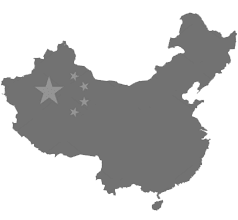
For tourists seeking extraordinary trips, China offers both unforgettable landscapes but also a civilization and culture that goes back several millennia. On an absolutely immense territory, 23 monuments are included in the world heritage and the sites to visit abound there like Guilin, the Five Sacred Mounts with their marked paths, or the banks of the Yangtze. To discover China is also to immerse oneself in a radically different culture, to let oneself be overwhelmed by its traditions and its contrasts of landscapes. In short: to immerse ourselves in another world.
China's climate varies considerably depending on the geographical area in which you live. In the north, where Beijing is located, summer temperatures can easily exceed 30° while winters are extremely harsh. Central China, which hosts Shanghai, for example, has a continental climate, characterized by very hot summers and cold winters. Finally, the southern part of the country, where Canton, for example, is located, has a subtropical climate, with hot summers and mild winters.
A country with strong agricultural roots, China covers villages scattered throughout its territory, which is a real peculiarity. Like the large Chinese cities, these campaigns have a local artistic culture and some villages have even been recognized for their historical and cultural interest since the end of 2006 by China. Its geography is also very specific: there is a succession of high mountains with areas of plains and plateaus, decorated with numerous lakes, there are some 2000 throughout the country.
In 2015, China should build a national computer database on monuments. Meanwhile, the cultural sector benefited during the 1990s from a government investment of 700 million yuan, part of which was used to renovate monuments or damaged rooms. In 2004, the Tibet region also earmarked 70 million yuan for the restoration and protection of three major historic monuments: the Potala, Norbulingka and Sagy Monastery.
A trip to China means immersing yourself in a history that goes back more than 5000 years. The country has thus known different dynasties, including the Xia, Shang, or Zhou, each bringing its share of scientific knowledge and mastery. We know, for example, that under the Shang, the Chinese already knew how to make iron instruments. In later centuries, China also made other discoveries such as the manufacture of paper or powder.
The first feudal state of centralized power was born in China in 221 BC. It's the Qin dynasty. It was followed by many others until the revolution of 1911, which put an end to the monarchy and established the provisional government of the Republic of China. Another important milestone: the People's Republic of China was founded on 1 October 1949.
Today, the country has a population of 1.3 billion, or one fifth of the world's population, and a strict birth policy is in place to control population growth. China is also the third largest country in terms of area, with an area of 9.6 million square kilometers. A majority of economists believe that this country will be the most powerful world economy in the next twenty years. 50 million tourists go there every year.
Art and culture in China
The evolution of Chinese calligraphy has given birth to an art of writing in itself and remains very dynamic in contemporary China. Each dynasty left traces of its own form of calligraphy. Chinese painting is an art that is also associated with it: paintings of characters, landscapes, flowers and birds are thus an integral part of traditional Chinese painting.
What to visit in China
China attaches great importance to its cultural heritage, consisting of nearly 400,000 monuments. There are many must-see monuments to visit, but if only a few were to be retained, you would opt for Beijing and its Great Wall, The Forbidden City, the Summer Palace, the Dingling Tomb. In the city of Xi'an, the statues of the warriors and the terracotta horses of the Qin are also worth a visit. An escapade to Shanghai, and it is the beauty of the Huangpu district as well as the Nanpu bridge and its acrobatic shows that invite you to discover.
China, a country-continent so present in our daily lives through manufactured products "made in China" and yet such a distant and mysterious country... As part of the preparation of our world tour, I listed with Magda at least 10 things we would like to see in China. Some are known by all, others much less...
1- The Forbidden City
One cannot speak of China without mentioning the imperial palace built at the beginning of the 15th century under the Ming era and which today houses a museum. Stretching over 72 hectares, this monument that the Chinese simply call S’étendant "the ancient palace" is the largest architectural complex in China.
Located in the heart of the Chinese capital, a stone's throw from Tian'anmen Square further south, this marvel has been on UNESCO's World Cultural Heritage List since 1987.
2 - The warriors and the terracotta horses of Emperor Qin Shi Huang
Warriors and terracotta horses are found 1.5 km east of Emperor Qinshihuang's tomb in Xi'an Lintong district. In this site, on which we find several pits (4 exhumed to date), there are more than 8000 statues of warriors (almost all different faces) and horses as well as weapons whose realism is striking, testimony of the refinement of Chinese art comparable to the precision of the Hellenistic style.
3 - Emei Shan
Mount Emei Shan, a UNESCO World Heritage Site, is a sacred place from which the Buddhist religion spread throughout South East Asia. Culminating at more than 3000m of altitude, one finds at its top the golden temple and the copper temple to which one reaches by a monumental staircase, guarded by imposing statues of elephants on both sides of the road.
4 - The Yangtze River and the Three Gorges Dam
One of the three largest dams in the world, a Chinese technological feat, an ecological aberration for others, this high place of Chinese civil engineering leaves no one indifferent.
5 - The Great Wall
No, it is not visible from the moon as some claim. About 6,700 km long, the Great Wall is actually the junction of several sections of walls that were built under different eras from the 3rd century B.C. until the 17th century. These fortifications were to protect the northern border of China.
6 - Jiuzhaigou: the "valley of the nine hamlets
This valley inhabited by Tibetans did s´est open to the outside world only in 1995 with the construction d´une road. Its access remains difficult to this day. Jiuzhaigou is located in a nature reserve in Sichuan (south-west). Known for its Wuhuahai lake and waterfalls, Jiuzhaigou is also home to Tibetan villages.
The site comprises more than 100 lakes over 600 km2. Each of them has an evocative name: Lac du Cygne, Lac du Bambou, Lac de Fleur à Cinq Pétales, Lac du Miroir ...
7 - The Potala Palace
Former private palace of the Dalai Lamas (the fourteenth Dalai Lama now resides in Dharamsala in northern India), the Potala Palace is now a museum. Built at 3700 m altitude, it consists of two palaces: the red palace and the white palace.
The white palace is the part of the palace that was used for the Dalai Lama's residential quarters while the red palace was used for religious study.
8 - The famous "Longmen Caves
13 km south of Luoyang city in Henan province, on the banks of the Yishui river are the famous caves. Begun at the end of the 5th century AD, their construction spread over 400 years and there are more than 100,000 Buddhist statues spread over nearly 2,345 caves or niches.
The best known are the Guyang, Binyang and Lianhua caves dating from the Northern Wei dynasty (386-534) as well as the Ten Thousand Buddha Cave, dug under the Tang (618-907).
Don't miss also the Guyang, Binyang and Lianhua caves dating from the Northern Wei (386-534) as well as those of Qianxisi, Fengxiansi, Kanjingsi and the Ten Thousand Buddhas cave, dug under the Tang (618-907).
9 - Yangshuo rice fields
The rice fields around the town of Yangshuo can be discovered by renting a bicycle.
If you wish to admire the rice terraces, you will have to go a little way that will take you 200 km further (return your bicycle before eh), in the region of Longsheng. There, you will be able to contemplate the terraced rice fields of the dragon's back.
10 - The Pagoda Forest ( Shàolín Sì)
Gigantic cemetery built in homage to the high monks of the Shaolin temple, the Pagoda Forest is composed of 246 pagodas whose origin goes back to the Tang dynasty (791 AD). It is one of the best known places for this type of buildings in China. The forest stands 2 min walk west of the Shaolin Temple.
Gastronomic specialities in China
A geographical North/South division confirms two distinct culinary traditions: in the cuisine of the North, pasta plays a predominant role and the cuisines of Beijing, Tianjin and Shandong are the best known local gastronomies. We will thus appreciate to taste in the capital dishes like the lacquered duck and the ravioli with fish and vegetables. On the other hand, southern cuisine is much more spicy and is accompanied by rice and rice products. As for drinks, the local beer is of very good quality: Qindao or Tiger Bear have a very good reputation. So try it in moderation during your stay in a hotel in China.