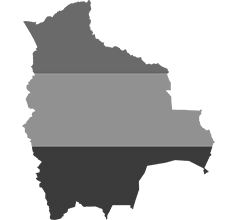
Bolivia is probably not the most economically prosperous country in Latin America. But this nation, which shares borders with Brazil, Paraguay, Argentina, Chile and Peru, is based on a much greater wealth: that of the multi-ethnicity of its population made up of Amerindians, Europeans, Asians, Africans and Métis.
This variety is also reflected in the multitude of languages spoken in the country: no fewer than 37 are officially listed in the constitution, creating a true cultural diversity, whose literature, music or art retain many stigmata.
This plurality also affects Bolivia's magnificent landscapes: from the mountain panoramas of the Andes Cordillera to the Altiplano plateau, the cradle of most Bolivians, passing through a succession of plains that give access to the Amazon forest, the country is extremely varied and some of these places are particularly surprising.
The Salar of Uyuni, this immense salt desert situated at an altitude of more than 3600 metres, was formed some 40,000 years ago and extends over 150 kilometres by 100.
In the list of curiosities, the lake Titi Caca is also in good place: if this lake is not as big as the Maracaibo in Venezuela, it holds on the other hand the palm of the longest lake of the continent of South America and that of the highest lake where one can sail. The legend, transmitted by the Indians of the Andes, tells that the first Inca would have left its waters...
Full of mystery and founding myths, Bolivia will also seduce lovers of high altitude sports: the Cordillera Royale, characterized by different peaks over 6000 meters high, is ideal for both skiers and trekkers or lovers of unique natural landscapes.
La Paz, at an altitude of some 3700 metres, is not far away and offers a complementary face with its procession of museums, including the National Museum of Art, the National Museum of Archaeology Tiwanaku, famous for the richness of its collection of pre-Columbian art remains, or the Museum of Ethnography and Folklore.
Not far away, one can also discover the Valley of the Moon, whose aspect is the consequence of thousands of years of erosion.
Finally, among the Bolivian cities that also deserve the detour, we will not miss a trip to Santa Cruz de la Sierra, located in the department of the same name.
This city, still little visited at the beginning of the XXth century, is interesting because of the juxtaposition of its colonial architecture and a new tendency, more minimalist which developed throughout the last century.
Located more than 230 kilometres southeast of La Paz, Cochabamba is particularly known for the profusion of its parks and gardens, which have earned it a reputation as a garden city. This city is also considered as the gastronomic capital of Bolivia.
If you feel like staying in Bolivia
The difficulty is to find the ideal season. If the general climate of the country is hot and humid, its conditions are in reality very different according to the altitudes: whereas it will be humid and relatively mild in plain, the climate will be on the other hand cold and dry in the Andes.
The thermal amplitude during the same day can be very important: for example, in La Paz, from November to March, temperatures can very well reach 20 degrees during the day to gradually retreat and descend to negative temperatures in the evening and at night.
Conversely, the valley of Cochabamba, as in many valleys of medium altitude, 2500 meters, temperatures oscillate between 18 and 19 degrees on average. The little wool is therefore always required!
Beware of the water you drink: in Bolivia, it is far from drinkable everywhere and even in the most developed regions and cities. Bottled water should be used as often as possible. Alternatively, you can always quench your thirst with Coca Colla, made from coca leaf extracts. Nothing to do with the carbonated drink with a very similar name except for its colour and packaging.
Art and culture in Bolivia
Bolivian cuisine contains a number of basic ingredients, such as potatoes. This starch is especially used in el aji de papalisa, which is a dish that can also be cooked with onions and meat. In addition to a multitude of cereals, quinoa for example, Bolivian dishes are usually spiced with peppers, especially chicken such as tongue or beef skewers. Because the quality of the meat is most often exquisite, Bolivia offers very good grilled meat so let yourself be tempted by parilladas or chicharrones, these grilled pork pieces.
What to visit in Bolivia
During your hotel holidays in Bolivia, you will have to go to La Paz, the highest capital in the world: one goes there for the multitude of its museums but also for its markets like the Mercado Rodriguez, which reaches its peak of animation during the weekends. For those who like to go out at night, we also like to visit the Calle Belisario Salinas in the Sopocachi district, where there are many bars. Near La Paz, you can go to Lake Titicaca. Also worth seeing when renting a car in Bolivia: the Salar de Uyuni, the salt desert. The surprise effect is guaranteed.
Gastronomic specialities in Bolivia
Weaving is a major art in Bolivia, developed by the Quechuas and Aymaras Indian tribes. This art is used in particular for the manufacture of clothing, always very bright colors. Andean music is also an important component of the culture of this country. The main instruments include notched flutes, quenas and zamponas that you can bring back as souvenirs of your flight to Bolivia.