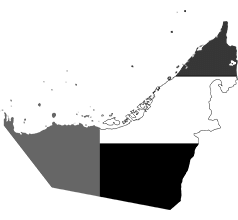
Dubai is the first city in the United Arab Emirates (in front of the federal capital Abu Dhabi). Located on the Persian Gulf, it is the capital of the Emirate of Dubai, and has more than one million inhabitants (however, along with the cities of Sharjah, Ajman and Ummah al-Qa' kwain, which are themselves capitals of their respective emirates, it forms an agglomeration that exceeds 2.3 million inhabitants in 2010). Dubai is also the country's leading port. Founded in the eighteenth century, Dubai remains a modest and isolated village that lives mainly from pearl fishing at the end of the nineteenth century. At that time, like the emirate around it, they gained importance by taking part in the founding of the Truce States in 1853. Having lived through a difficult period between the two world wars, Dubai took part in the creation of the present United Arab Emirates in 1971, whose emir became vice-president of the United Arab Emirates.
Although not the capital of the United Arab Emirates, Dubai has become the most famous city of the federation.
This renown is due in particular to the media coverage of its tourism projects such as the Burj-Al-Arab hotel, Dubai's most luxurious hotel, to the gigantism of real estate projects such as Palm Islands, an artificial peninsula in the shape of a palm tree, The World, an artificial archipelago that reproduces the world map, the Dubai Marina with its particular and disproportionate architecture, without forgetting the world's tallest building, the Dubai Marina.
Skyscrapers, shopping, and incredible monuments
Walking through the city centre, it's hard to miss the main attractions of the city centre that Dubai boasts: Dubai's shopping mall (the largest shopping mall in the world and the most visited shopping and leisure area), the Burj Khalifa (the tallest building in the world) and the JW Marriot Marquis (the highest hotel in the world). Leaving aside these historic records, visitors will find many activities for family and friends, such as the Dubai Fountains, the Dubai Aquarium and Underwater Zoo, the Dubai Skating Rink and the Souk.
Trendy restaurants and live music
This district, whose name is not so creative as that, is the location of the city's main publishing groups - think of magazines, newspapers and TV channels - but Media City and its neighbourhood, Internet City, are also home to restaurants frequented by creative personalities both during working hours and after work. Meet at the Mazaj Restaurant for lunch around an excellent mezze, with famous dishes such as grilled haloumi, baba ganoush and hummus served hot with pine nuts, or stroll around the lake and go to the Urban Bistro or Circle Café - juxtaposed restaurants offering fresh and balanced meals for lunch. The Media City Amphitheatre - right next door - is one of the best outdoor venues in Dubai, and hosts everything from markets to music festivals and rock concerts. As a bonus: the Media One Hotel, with its spectacular views on the 42nd floor, is just across the street; it's the perfect place to have a drink.
From the street, Al Quoz seems to be like all the other industrial suburbs of medium-sized cities, with streets full of warehouses without any particularities. However, art lovers who visit Alserkal Avenue will discover Dubai's emerging cultural district. Alserkal Avenue has 20 permanent art spaces, such as the Salsali Private Museum, the first gallery in the Middle East's contemporary art region; Carbon 12 Dubai, which brings together works by international artists; but also numerous art and cultural events not to be missed. Creativity seekers will find satisfaction in one of Al Quoz's very exciting cafés, such as the Lime Tree Cafe and the popular Tom & Serg.
Family leisure activities with sea view
A long stretch of shoreline parallel to the Sheikh Zayed Road, Jumeirah Beach is the location of many of the city's attractions, such as the iconic Burj Al Arab Hotel, the Madinat Jumeirah Hotel and Entertainment Complex and its souk, and Wild Wadi Culminant Water Park at the Jumeirah Beach Residences (known by the acronym JBR for premises), the neighbourhood includes The Beach, one of Dubai's newest shopping malls - designed for pedestrians (family or friends). Visitors will find it so easy to spend all day - and even the evening - in The Beach, thanks to its hundreds of restaurants, retail outlets and cinema. A few steps away, you can go to the beach with a picnic basket and blanket, or take your children to the imaginative playground dedicated to them or enjoy the fitness equipment at your disposal.
Take the tram and stop two stops after the JBR (Dhs 5), or take a taxi (Dhs 20-25) and head to the Dubai Marina Shopping Centre, which is located in the heart of the impressive Dubai Marina district. Take a walk and go to the docks, where you can sit outdoors in most of the restaurants along the seaside. See how the marina's waters reflect the surrounding tall buildings, like the iconic Cayan Tower with its 90 degree staggered floors that turn on themselves. Here, most restaurants are open until after midnight, and rides and other stands will be there to entertain the whole family on their way before or after dinner. The latest marina project, Pier 7 (the Pier 7), is a destination for gourmets: the tower in the middle of the pedestrian walkway houses seven very different - but equally delicious - restaurants on each of its levels.
Quiet cafes and playgrounds
Located in front of Dubai's Marina is Jumeirah Lake Towers, these are residential towers and offices made entirely of glass, and their artificial green lake gave its name to the area. Although it used to be a rather quiet area, the JLT has attracted the attention of tourists thanks to its many cafés, such as the new Friends' Avenue, but also thanks to its restaurants run by expatriate families, such as the famous restaurant Le Homey or the bustling Urban Bar & Kitchen, located within the Moevenpick Hotel. A new landscaping project that has introduced lush lawns, an interactive children's playground and other common community activities, as well as neighbourhood celebrations, make the JLT an ideal option for young families' stays and entertainment.
The taste of tradition
The former centre of the city and better known as Old Dubai, this area unites all the neighbourhoods around Dubai Creek. Today, Deira is known for its gold markets and spice souks, and fresh produce markets at the dhows' quays (dhows are long open boats, similar to gondolas, which are traditionally used by merchants). Just a few minutes by boat to the south of the creek, you will find the Bur Dubai, which hosts some of the best ethnic restaurants typical of the city, with many authentic Arab, Persian, Moroccan and Lebanese menus waiting to be discovered.
High-end hotels and luxury beach clubs
One of the most emblematic monuments of the city, the island of Palm Jumeirah comes at the top of the list for many visitors. One of the largest artificial islands in the world, it is home to another unique feature - the pink arches and turrets of the Atlantis Hotel, visible to travellers taking the island's main road. High-end hotels are the island's main asset, with international hotels such as Anantara, Fairmont and Waldorf Astoria represented alongside The Palm's Trunk (known as The Golden Mile) and the Crescent Tower (residential villas within The Palm). Even if you've decided not to stay on The Palm, this iconic neighborhood is worth the detour for its gourmet restaurants, luxury spas, beautiful beach clubs and breathtaking views of the Gulf's waters.